 By
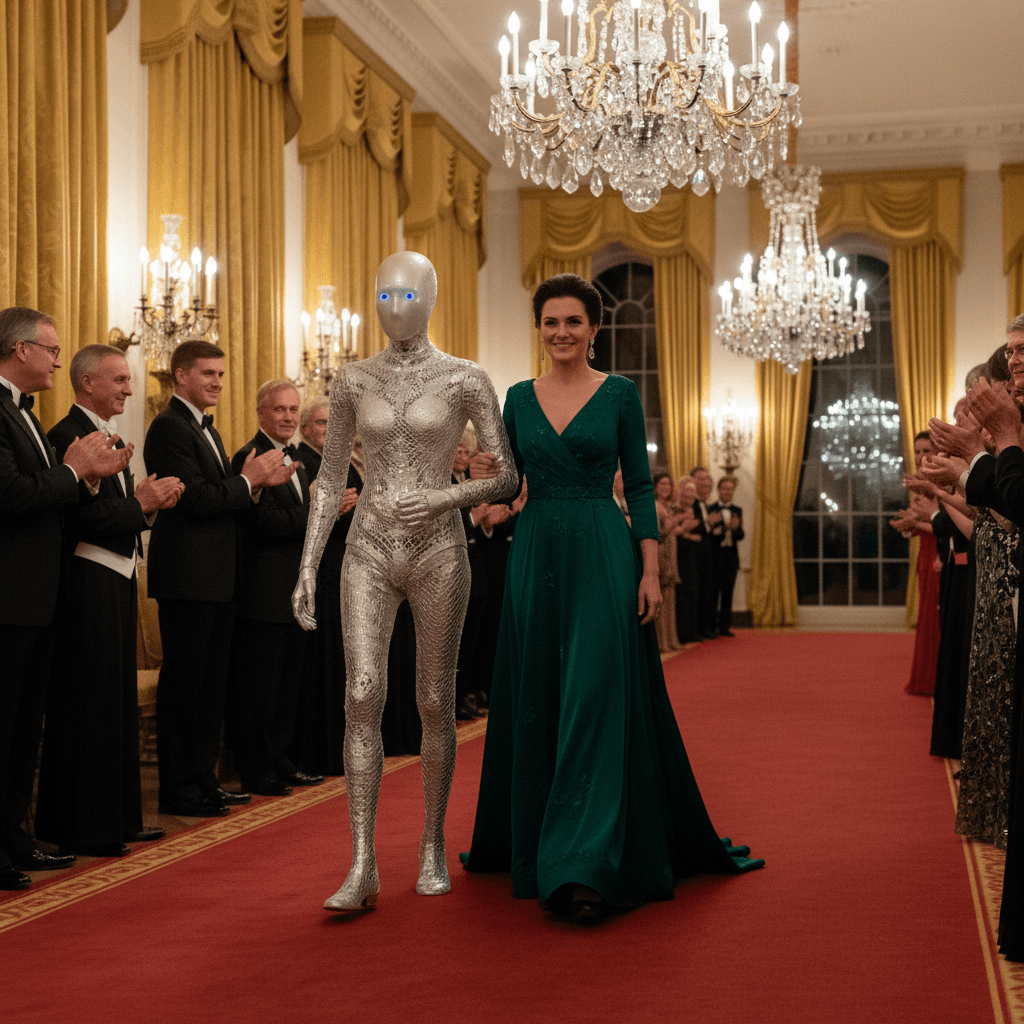
By On Tuesday afternoon, a 5-foot-8-inch robot in mesh fabric walked alongside First Lady Melania Trump into the White House East Room. It greeted attendees in 11 languages. It said it was "built for the United States of America." Then it stood there while diplomats from more than 45 countries looked on.
That robot was Figure 03, made by Figure AI. And yes, this actually happened.
What happened
The appearance came on the second day of the "Fostering the Future Together Global Coalition Summit," a diplomatic gathering organized with first ladies from nations including France, Poland, and Sierra Leone. Figure 03 accompanied the First Lady along a red carpet before the event, greeting guests as they arrived.
"Figure 03, thank you for joining me. It's fair to state you are my first American-made humanoid guest in the White House," Trump said, according to NBC News and NPR. The robot replied: "Thank you, first lady Melania Trump, for inviting me to the White House. It is an honor to be at Fostering the Future Together's global coalition inaugural meeting."
At another point, Figure 03 introduced itself: "I'm Figure 03, a humanoid built for the United States of America."
Figure AI CEO Brett Adcock posted on X that he was "proud to see F.03 make history as the first humanoid robot in the White House."
The robot itself
Figure 03 is the third-generation platform from Figure AI, a Sunnyvale-based company Adcock founded in 2022. Introduced in October 2025, it was designed primarily for household tasks: laundry, cleaning, dishes. The hardware specs matter here. It stands 5'8" and weighs approximately 135 lbs, with cameras embedded in the hands and tactile sensors throughout the body. The mesh fabric covering keeps the mechanical structure visible while softening the silhouette for human environments.
The brain is a system Figure AI calls Helix AI, a vision-language-action model. That architecture is worth understanding. VLA models process raw visual input from the robot's cameras alongside verbal commands and translate both into physical actions in real time. It is not a traditional decision tree or scripted response set. The model reasons continuously from camera data and language simultaneously, which is what allowed Figure 03 to handle live multilingual greetings without pre-canned responses keyed to each language.
Figure AI raised more than $1 billion in a Series C round in September 2025, putting its valuation at $39 billion. Investors include Nvidia, Intel Capital, Qualcomm Ventures, and Salesforce. The company's first commercial customer was BMW, where Figure robots handle sheet metal in manufacturing lines, a very different context from a diplomatic reception.
Why this appearance is strange
The White House appearance was not a product launch or a government contract announcement. Neither the White House nor Figure AI responded to media requests for comment, per NPR and NBC News. There are no reported federal contracts between Figure AI and any agency.
Melania Trump's framing pointed toward education. "Very soon, artificial intelligence will move from our mobile phones to humanoids that deliver utility," she said, according to NBC News. "Imagine a humanoid educator named 'Plato.' Access to the classical studies is now instantaneous." That is a vision statement, not a policy announcement, but it comes with the weight of a White House setting.
The event's audience was international. Forty-five first ladies watching an American-made robot introduce itself as "built for the United States of America" carries a different weight than the same demo in a convention center. Whether that framing was intentional is genuinely unclear.
What is clear: Figure AI received an extraordinary platform for its technology with no publicly disclosed arrangement to explain how it got there.
The context you should know
Figure AI is not without controversy. In November 2025, the company was sued by Robert Gruendel, its former head of product safety, who alleged wrongful termination after warning that robots could "fracture a human skull" under certain conditions. Figure AI countersued Gruendel in January 2026. The litigation is ongoing.
Adcock has made his economic thesis explicit on Figure AI's website: "Today, manual labor compensation is the primary driver of goods and services prices. As these robots 'join the workforce,' everywhere from factories to farmland, the cost of labor will decrease..." That framing, humanoid robots as a cost-deflation mechanism for physical labor, makes the White House appearance more pointed. This was not just a tech demo. It was a vision of workforce transformation being shown to international dignitaries inside a building that represents American policy.
What comes next
Figure 03 is commercially deployed in industrial settings via BMW, but the household applications Melania Trump described remain at an earlier stage. The VLA architecture has proven capable in controlled environments. Whether it scales to unstructured home or institutional settings is a real open question that no current public benchmark fully answers.
For Figure AI, a White House appearance is the kind of visibility no marketing budget buys. The practical question is whether that visibility translates into the customer relationships and deployment volume needed to justify a $39 billion valuation. Industrial robotics deployment cycles are long, and BMW's sheet metal lines are a different pipeline from consumer households or government facilities.
The robot greeted diplomats in 11 languages and said the right things. The harder questions about safety litigation, workforce displacement, and how a private company ended up in the East Room are still waiting for answers.
Paul Menon covers technology and AI for The Daily Vibe.