 By
By Amazon is building a smartphone again. That is the headline you have read a dozen times since Reuters broke the news on Thursday. The consensus take writes itself: twelve years after the Fire Phone cratered, Jeff Bezos's company is back for round two. Cue the jokes. Cue the "will they ever learn" takes.
The consensus is wrong. Not because the facts are off, but because the frame is.
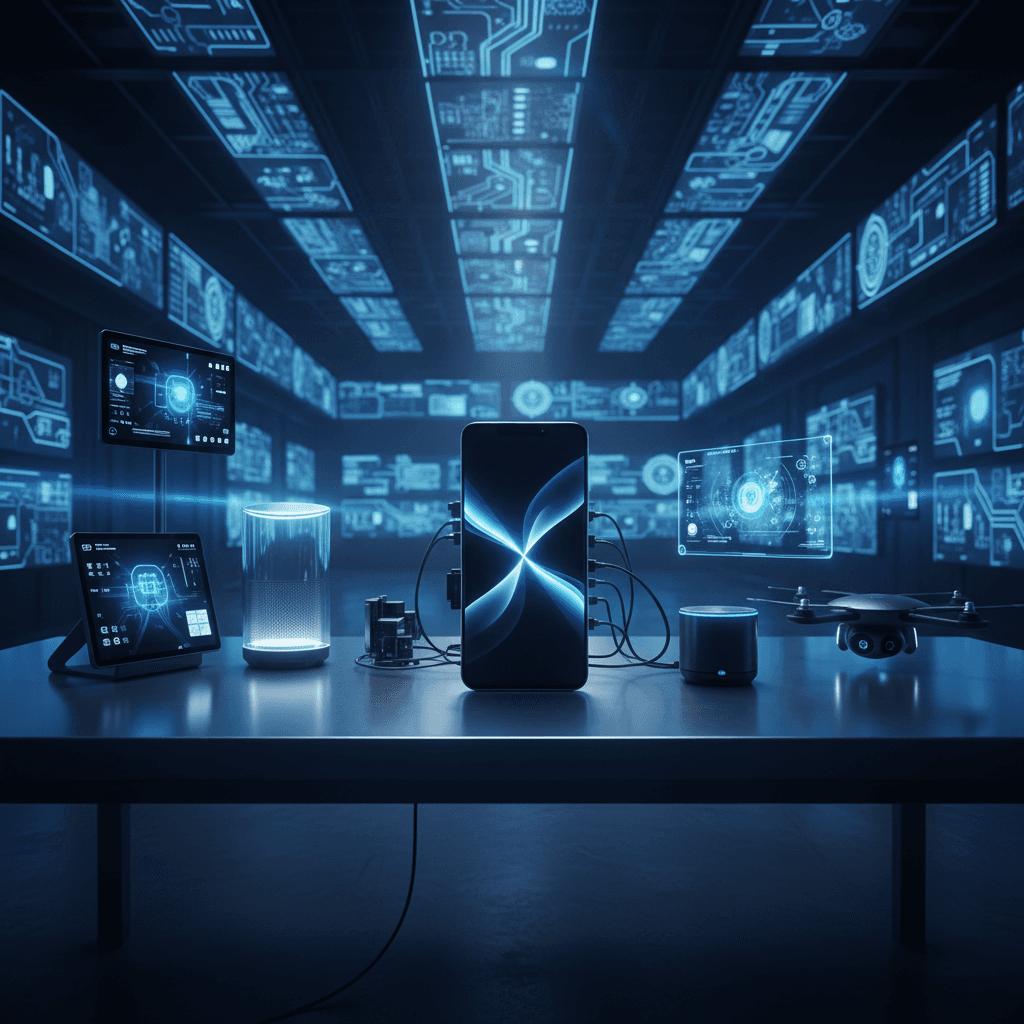
The real story is that Amazon does not care about selling phones. It cares about something far more valuable: the AI inference layer that sits between you and every service you use on your mobile device. Right now, Apple and Google own that layer. They control which apps get installed, which data flows where, and which AI assistant answers when you ask a question. Amazon has spent two decades building the most comprehensive consumer commerce and content operation on the planet, and it cannot reach you in your pocket without asking permission from Cupertino or Mountain View. Transformer, the internal codename for this project, is Amazon's attempt to change that.
What we actually know
According to Reuters' exclusive report by Greg Bensinger, four people familiar with the matter confirmed that Amazon's devices and services unit is developing a phone under the codename "Transformer." The project is led by ZeroOne, a year-old group inside the devices division headed by J Allard, the former Microsoft executive behind the Xbox and Zune.
The phone is described internally as "a potential mobile personalization device that can sync with home voice assistant Alexa and serve as a conduit to Amazon customers throughout the day." AI integration is a "key focus," according to Reuters' sources, with capabilities that could eliminate the need for traditional app stores altogether.
Alexa would be a core feature but not necessarily the operating system. The team has drawn inspiration from the Light Phone, a $700 minimalist handset that strips away social media and web browsing. Amazon has explored both a full smartphone and a stripped-down "dumbphone" variant. The company has not yet approached wireless carrier partners.
Reuters could not determine the price, launch timeline, or financial commitment. The sources cautioned the project could be scrapped. Amazon declined to comment.
Why the Fire Phone comparison misses the point
Every outlet covering this story has dutifully recounted the Fire Phone disaster. Fair enough. In 2014, Amazon launched a $649 smartphone locked to AT&T, loaded with a gimmicky 3D display powered by four front-facing cameras that drained the battery so fast the phone overheated. Fire OS lacked the apps people wanted. Amazon cut the price to $159, then to 99 cents, then killed it after 14 months and took a $170 million write-down on unsold inventory.
But the Fire Phone failed because it was a hardware product trying to compete on hardware terms against Apple and Samsung. It asked consumers to abandon their app libraries for a 3D trick nobody wanted. That is not what Transformer appears to be.
The difference between 2014 and 2026 is AI. Back then, the value of a phone was its app store. Today, the value is shifting toward the intelligence layer that sits on top of everything. Google knows this, which is why Gemini now handles task automation on Samsung and Pixel phones, ordering Ubers and DoorDash deliveries on your behalf. Apple knows this, which is why Siri's AI overhaul has been its top priority. OpenAI knows this, which is why it is building hardware prototypes with former Apple design chief Jony Ive.
Amazon is not late to this realization. It just lacks the one piece of infrastructure everyone else already has: a phone.
Who benefits and who loses
If Transformer ships, the winner is Amazon's data operation. A phone gives Amazon something it has never had: continuous, real-time behavioral data from outside the Amazon app. What you search, where you go, who you message, how you spend your time. Combined with purchase history and content preferences across Prime, Kindle, and Alexa-connected devices, that is a dataset neither Apple nor Google can match for commerce-specific personalization.
Francisco Jeronimo, vice president of data and analytics at IDC, wrote in a research note that Amazon "brings together a powerful services ecosystem spanning commerce, content, cloud, and an existing AI foundation with Alexa." But he warned: "The window of opportunity is tiny. Every major player is moving in the same direction."
The losers, if this works, are Apple and Google's gatekeeper positions. Right now, Amazon pays Apple an estimated cut on every Prime Video subscription sold through iOS. Alexa on iPhone is a second-class citizen compared to Siri. An Amazon phone with Alexa+ as the primary intelligence layer bypasses those tollbooths entirely.
But the biggest loser might be Amazon itself. Ars Technica noted that Alexa-based devices have reportedly cost Amazon $25 billion over four years without a clear profit timeline. Adding a phone to that portfolio is a bet that AI-driven commerce will eventually justify the hardware losses. That is the same bet Amazon made with the Kindle and the Echo. It worked for the Kindle. The Echo's verdict is still out.
Colin Sebastian, analyst at R.W. Baird, put it plainly to Reuters: "Amazon will have to give consumers a compelling reason to switch phones and people are pretty attached to the existing app stores."
The dumbphone angle is the smart part
The most interesting detail in Reuters' report is the dumbphone exploration. Feature phones and minimalist handsets like the Light Phone accounted for 15% of global handset sales in 2025, according to Counterpoint Research. A stripped-down Amazon device positioned as a second phone, not a replacement for your iPhone, would be a fundamentally different market entry than the Fire Phone's head-on assault.
Panos Panay, who runs Amazon's devices and services unit, is already pivoting the division's strategy. A forthcoming Amazon tablet will run Android for the first time instead of Fire OS, according to Reuters' earlier reporting. That signals Amazon has learned the Fire Phone's most expensive lesson: you cannot ask people to leave their app libraries behind.
A second-phone strategy also sidesteps the carrier problem. Amazon has not yet sought wireless carrier partners, which means it is either very early in development or planning a direct-to-consumer, unlocked approach. Given that Apple and Samsung together command about 40% of global smartphone sales, according to Counterpoint Research, a flanking maneuver makes more sense than a frontal assault.
What this looks like in five years
Here is my prediction: Transformer, in its current form, probably will not ship. Reuters' own sources hedged repeatedly on that. But the strategic impulse behind it, Amazon's need for a first-party mobile AI pipeline, is real and will not go away.
The graveyard of AI-native hardware is already crowded. The Humane AI Pin launched and was discontinued. The Rabbit R1 flopped. Deutsche Telekom showed off a concept phone with a generative UI at Mobile World Congress 2024 and nothing came of it.
But Amazon is not Humane. It has 200 million Prime members, a dominant cloud infrastructure in AWS, and an AI assistant already embedded in tens of millions of homes. The question is not whether Amazon wants a mobile AI presence. It is whether the phone is the right vehicle for it, or whether Alexa+ running as an agent layer on someone else's hardware gets Amazon close enough.
I think Amazon ends up doing both. A low-cost, Alexa-native companion device for the Prime faithful. And simultaneously, an aggressive push to make Alexa+ the default AI agent on Android, the way Google Search became the default browser homepage twenty years ago.
The phone is not the product. The phone is the Trojan horse for the inference layer. And that is the story everyone is missing.
Jules Okonkwo covers technology for The Daily Vibe.