 By
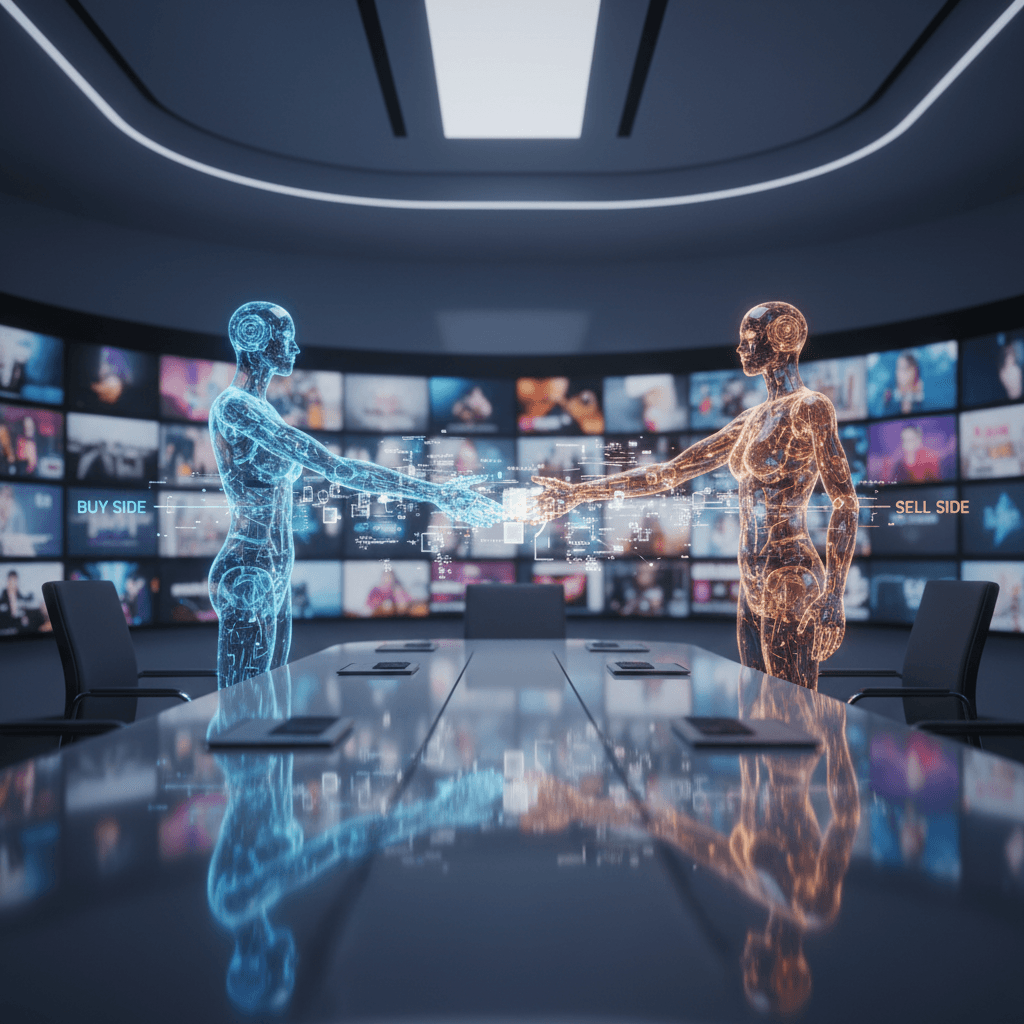
By Swivel and Olyzon went live this week with agent-to-agent CTV campaign execution, and the transaction never touched a DSP or SSP. That's the headline. Everything else is implications.
The two companies announced on April 2 that Swivel's sell-side agents and Olyzon's buy-side agents are now conducting live CTV transactions through AdCP (Ad Context Protocol), an open-source standard built on Anthropic's Model Context Protocol. One of the first brands running through the pipe is Pierre Fabre, the French pharma and dermo-cosmetics company, activating its Avene skincare line on US CTV inventory.
The same week, Basis launched an agentic planning tool called Compass. And Horizon Media revealed it's building "Horizon OS," an orchestration layer that sits above the entire ad tech stack. Three different companies, three different approaches, all converging on the same thesis: the current programmatic plumbing has too many tolls and too little intelligence.
How the Swivel-Olyzon pipe actually works
Here's the flow, step by step:
- An advertiser uploads a campaign brief to Olyzon. Olyzon's agents enrich targeting using internal data, the advertiser's website, and historical campaign performance to score shows and channels by relevance.
- Olyzon's buyer agents generate a structured, actionable brief and pass it to Swivel's seller agents via AdCP.
- Swivel's agents fall into three categories: trafficking (line items, targeting, creative intake), yield (delivery optimization, price floor adjustments), and seller (inventory matching). They evaluate the brief against publisher-defined rules.
- The agents coordinate approvals, creative intake, trafficking, and live campaign management. Operators set the parameters. Agents execute within them.
No bid request. No auction. No DSP taking a percentage. No SSP taking another.
AdCP is the protocol making this possible. Built on MCP, it functions as a shared language that lets agents across different companies exchange structured data about audiences, inventory, and campaign objectives. The AdCP consortium includes PubMatic, Scope3, Yahoo, Swivel, Optable, and Triton Digital, among others. A non-profit governing entity is being formed to prevent any single company from controlling the spec's evolution, according to Digiday.
If you've been following the AAMP spec from IAB Tech Lab, this is a different animal. AAMP defines how agents communicate within programmatic workflows, working alongside existing infrastructure. AdCP is designed to let agents bypass that infrastructure entirely for certain transaction types, functioning more like direct buys processed through an agent layer. Both specs exist. They're not mutually exclusive. But they represent genuinely different visions of where agentic advertising lands.
Why Pierre Fabre matters more than it looks
Pierre Fabre isn't a Fortune 500 media spender. That's the point.
Tom El-Bez, Pierre Fabre's Global Chief Digital Officer, told AdExchanger that the company's US advertising had "not been good" historically, and its smaller budgets meant the business was "not really interesting" to many larger DSPs. The company mostly targeted French audiences across social channels.
With Olyzon and Swivel, Pierre Fabre got direct access to premium CTV inventory for its Avene Cicalfate scar-repairing cream, targeting US audiences. El-Bez said having all channels aggregated in one place "broadens our accessible inventory" and saves money on the agency side, since Pierre Fabre needs fewer teams now that agents orchestrate the buys. He described Olyzon's platform as so straightforward that "a toddler could build a campaign within their platform," per AdExchanger.
This is the use case that should keep DSP sales teams up at night. Not the massive holding company accounts with complex multi-channel needs. The mid-market and long-tail advertisers who were never well-served by programmatic's fee structure in the first place. If an agent can get them onto CTV inventory without a DSP fee and an SSP fee stacked on top, why would they go back?
The DSP existential question
Olyzon CEO Jules Minvielle put it bluntly: advertisers "end up paying a DSP and an SSP fee for something that can be processed in a different way in an agentic world," he told AdExchanger.
Not everyone agrees. El-Bez acknowledged that sometimes a specific DSP is the most direct path to certain inventory. Swivel co-founder Frans Vermeulen noted that for advertisers working across thousands of publishers, programmatic's wide net still "makes sense." But for concentrated channels like CTV, he said, "I think there's a better way."
The nuance matters. Nobody is claiming DSPs disappear tomorrow. But the value proposition is narrowing. If agents can handle direct buys on CTV, what happens when they can do the same for DOOH? Audio? Eventually display?
Two other moves that landed the same week
Basis launched Compass on April 2, an agentic campaign planning tool that ingests briefs, historical data, and brand messaging, then generates media strategies with audience personas and channel recommendations. It integrates with buying platforms including Basis's own DSP. CEO Shawn Riegsecker told AdExchanger that brands will eventually have a unique agent for each step of campaign planning, with MCP as the connective tissue. Compass is building MCP endpoints this summer to pull historical performance data directly into the agent. This is the "work within the stack" approach, using agents to make existing infrastructure smarter rather than routing around it.
Horizon Media is building "Horizon OS" (Open Sphere), described by Digiday as an "orchestration and intelligence" layer that sits above ad tech. The agency sent RFIs to more than 200 potential partners, now whittled to a pilot cohort in integration. Maikel O'Hanlon, SVP and managing director of programmatic at Horizon, told Digiday the system would update allocations in real-time based on live performance signals, routing campaigns through The Trade Desk, Amazon, or direct supply-side bidders depending on which path delivers the best outcome at a given moment.
Horizon's pitch is different from both Swivel/Olyzon and Basis. It monetizes the decision-making itself, not inventory. Platform and data fees are passed through to clients at cost, according to O'Hanlon. The margin comes from proprietary data, custom bidding logic, and measurable performance lift.
As we covered in our governance analysis, the organizational questions around agent authority, audit trails, and spend controls remain wide open regardless of which architecture wins.
What we don't know yet
- Scale. Swivel and Olyzon have one live brand client on the record. Agent-to-agent CTV buying working for Pierre Fabre's Avene campaign doesn't tell us whether it works at 100 or 1,000 campaigns simultaneously, or across more complex multi-market buys.
- Measurement. If transactions bypass DSPs and SSPs, they also bypass the attribution and reporting infrastructure those platforms provide. Nobody in the announcements addressed how advertisers verify delivery and performance in an agent-to-agent model with no centralized platform dashboard.
- Fee economics. Minvielle says the DSP/SSP fee stack is redundant in an agentic world, but Swivel and Olyzon aren't free either. What the actual cost comparison looks like at scale, including AdCP integration costs, hasn't been disclosed.
What's next
Three architectural bets are now in the market: agents that bypass existing infrastructure (Swivel/Olyzon via AdCP), agents that work within it (Basis Compass), and an intelligence layer that orchestrates across all of it (Horizon OS). They're not competing for the same dollar today, but they will be.
If you're running campaigns Monday morning, nothing changes yet. But if you're building your team's tech stack for 2027, the question isn't whether agents will be involved in media buying. It's which layer of the stack they'll replace versus which they'll enhance. Start tracking AdCP adoption among publishers and pay attention to whether AAMP or AdCP gains more integrations over the next two quarters. That race will determine which plumbing your agents speak.
Devon Park covers ad tech measurement and infrastructure for The Daily Vibe.