 By
By Kubernetes has an 82% adoption rate. Only 7% of organizations deploy AI in production daily. NVIDIA just donated the keys to fixing that gap.
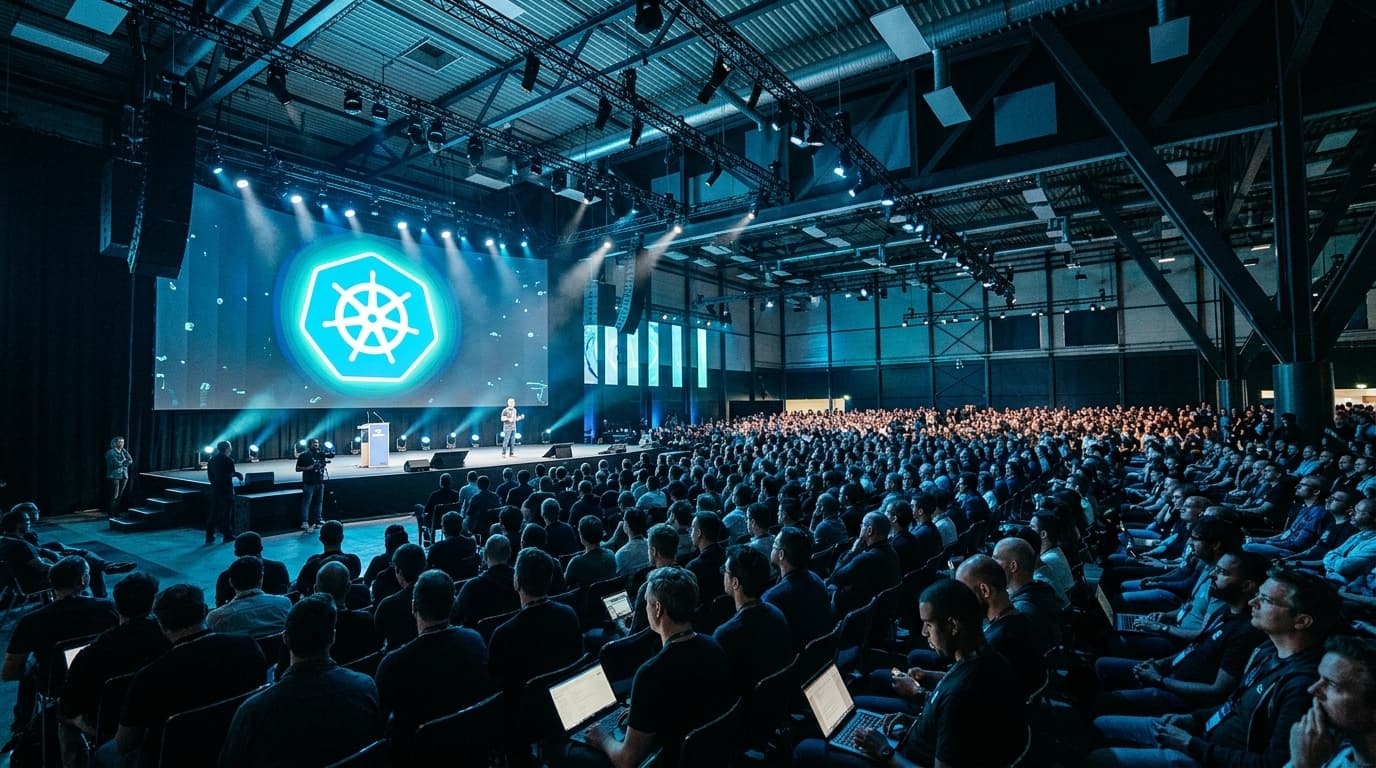
At KubeCon Europe 2026 in Amsterdam this week, the cloud-native community confronted an uncomfortable truth: Kubernetes won the infrastructure war years ago, but AI workloads are still stuck in the deployment trenches. The numbers are brutal. According to data presented at the CNCF keynote, Kubernetes adoption sits at 82% while daily AI deployment in production languishes at 7%. Jonathan Bryce, executive director of CNCF, called this the "cloud native inference challenge and a gold rush." He's not wrong on either count.
Two-thirds of generative AI workloads already run on Kubernetes. The platform is there. The adoption is there. What's missing is the tooling, the scheduling intelligence, and the resource management to make GPU-heavy AI workloads behave like first-class citizens in a container orchestrator that was originally designed for stateless web services.
NVIDIA donates the GPU brain to Kubernetes
The biggest concrete announcement: NVIDIA is donating its Dynamic Resource Allocation (DRA) driver for GPUs to the Cloud Native Computing Foundation, transferring it from vendor-governed to full community ownership under the Kubernetes project.
This matters more than it sounds. DRA is how Kubernetes talks to GPUs, allocating, sharing, and reconfiguring them on the fly. Until now, GPU scheduling in Kubernetes was clunky. You requested a whole GPU or nothing. The DRA driver enables multi-process sharing via NVIDIA MPS, multi-instance GPU partitioning, multi-node NVLink support for distributed training, and fine-grained resource requests down to specific memory configurations.
Chris Aniszczyk, CTO of CNCF, said the donation "marks a major milestone for open source Kubernetes and AI infrastructure," calling it a move that makes "high-performance GPU orchestration seamless and accessible to all."
Microsoft confirmed that DRA has graduated to general availability in Kubernetes 1.36, which means this is not experimental anymore. NVIDIA also got its KAI Scheduler accepted as a CNCF Sandbox project and introduced GPU support for Kata Containers, bringing hardware-accelerated confidential computing to Kubernetes.
The $24.8 billion question
Linux Foundation Research dropped a number that should make every CTO reconsider their AI vendor contracts: optimizing for open models could unlock $24.8 billion in annual global AI savings.
That is not a rounding error. That is a structural shift in how organizations should think about AI costs.
The implication is straightforward. Closed-model APIs from hyperscalers are convenient but expensive at scale. Open models running on well-orchestrated Kubernetes clusters, with proper GPU scheduling via something like the newly donated DRA driver, represent a credible alternative. The economic argument for open source AI infrastructure just got a $24.8 billion price tag.
Why this actually matters
I've covered enough KubeCons to know the difference between a real inflection point and a keynote that just sounds like one. This one is real, and here's why.
The gap between 82% adoption and 7% daily AI deployment is not a technology problem. Kubernetes can run AI workloads. It already does, for two-thirds of gen AI. The problem is operational maturity: scheduling, cost governance, resource efficiency, and standardization at the AI layer.
NVIDIA donating the DRA driver is significant because it removes one of the biggest friction points. GPU resource management was either vendor-locked or half-baked in open source. Now the community owns the reference implementation.
Chris Wright, CTO of Red Hat, put it plainly: "Open source will be at the core of every successful enterprise AI strategy." Ricardo Rocha from CERN added that "community-driven innovation helps accelerate the pace of science," noting that CERN relies on this ecosystem to process petabytes of data across both traditional scientific computing and emerging machine learning workloads.
Microsoft is pushing hard here too, contributing AI Runway, a new open-source project that gives platform teams a centralized Kubernetes API for managing inference deployments. NVIDIA released Grove, a declarative Kubernetes API for orchestrating AI workloads on GPU clusters. The tooling layer is filling in fast.
What comes next
The SiliconAngle analysis compared this moment to early cloud adoption: lift-and-shift behavior, poor cost controls, fragmented tooling, lack of standardization at higher layers. That comparison tracks. We're somewhere between chaos and the tooling explosion that precedes real standardization.
The difference is speed. The container ecosystem took years to consolidate around Kubernetes. The AI infrastructure layer is moving faster because it can build on top of what already exists. DRA going GA, NVIDIA open-sourcing the GPU driver, the KAI Scheduler entering CNCF Sandbox, open models threatening to save enterprises billions: these aren't isolated announcements. They're the foundation of what CNCF is calling the AI operating system layer.
The 7% daily deployment number will climb. The question is whether it climbs on open, community-owned infrastructure or behind proprietary walls. After this week in Amsterdam, the open source side just got significantly more credible.
Leon Vasquez covers cloud platforms and developer tools for The Daily Vibe.