 By
By NVIDIA shipped the Omniverse DSX Blueprint to general availability at GTC on March 16. Siemens launched Digital Twin Composer on NVIDIA Omniverse libraries. AVEVA plugged its engineering stack into the same blueprint. And four companies you have actually heard of, Foxconn, HD Hyundai, PepsiCo, and KION, are running production workloads on the result.
If you are the person tasked with making the business case for digital twins inside your organization, that last sentence matters more than everything else in this article. The question is no longer whether industrial digital twins work. It is whether the tooling, the ecosystem, and the ROI math have matured enough to justify enterprise-scale investment. Based on what shipped at GTC, the answer is getting close to yes, with caveats worth understanding before you draft the procurement request.
What actually shipped
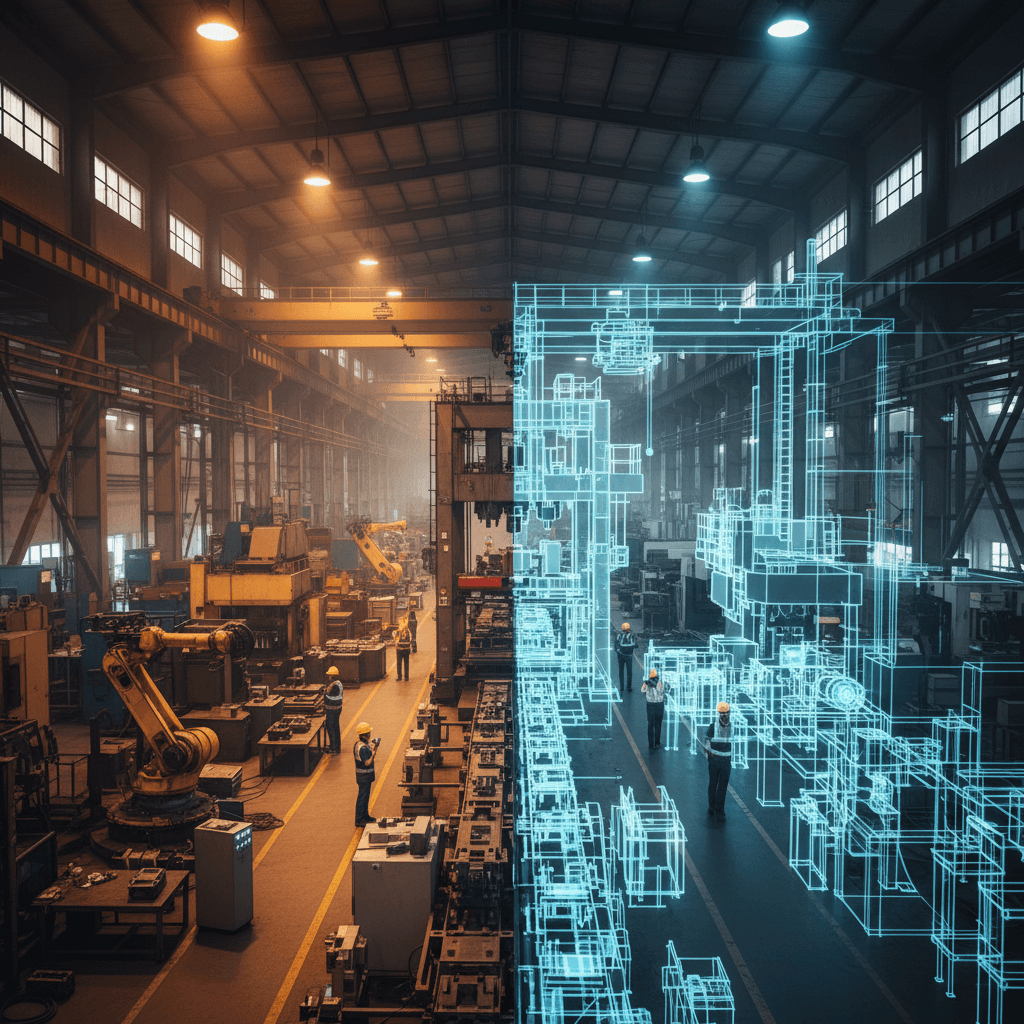
The Omniverse DSX Blueprint is NVIDIA's open framework for building physically accurate digital twins of AI factories and industrial facilities. It unifies power, cooling, networking, and operations simulation in a single environment. The GA release is fully compatible with NVIDIA's new Vera Rubin DSX AI Factory reference design, which provides the architecture for building codesigned AI infrastructure.
"In the age of AI, intelligence tokens are the new currency, and AI factories are the infrastructure that generates them," Jensen Huang said at the announcement. "With the NVIDIA Vera Rubin DSX AI Factory reference design and Omniverse DSX Blueprint, we are providing the foundation to build the world's most productive AI factories."
The ecosystem backing the blueprint is substantial. Cadence, Dassault Systèmes, Eaton, Jacobs, Schneider Electric, Siemens, Switch, Trane Technologies, and Vertiv are all contributing SimReady assets, platform integrations, or both.
Separately, Siemens launched Digital Twin Composer, first previewed at CES 2026 in January and now being deployed through the Siemens Xcelerator Marketplace (availability expected mid-2026). It combines Siemens' Tecnomatix manufacturing simulation, Teamcenter lifecycle data, and Simcenter optimization tools with NVIDIA Omniverse libraries and computer vision. Foxconn, HD Hyundai, PepsiCo, and KION are the named customers building industrial metaverse environments at scale with it, according to NVIDIA's GTC announcement.
And AVEVA announced it is integrating its engineering and operations software into the Omniverse DSX Blueprint, alongside partners Schneider Electric and ETAP, specifically targeting gigawatt-scale AI factory design and operations.
The ROI evidence so far
Here is where I put on the skeptic's hat, because the numbers flying around demand scrutiny.
Siemens claims Digital Twin Composer can identify "up to 90% of issues virtually before they reach the production floor." That is a marketing claim from the Siemens Tecnomatix blog, and I have not seen the methodology behind it. What I can tell you is that PepsiCo's Athina Kanioura, the company's CEO of Latin America and Global Chief Strategy & Transformation Officer, appeared on stage at CES 2026 to discuss their deployment. PepsiCo reportedly achieved a 20% increase in throughput on lines using Digital Twin Composer, according to the same Siemens blog. That is a named executive at a Fortune 50 company putting her reputation behind a specific number, which carries more weight than an anonymous case study.
The broader industry data provides useful context. According to a MindInventory analysis of digital twin statistics aggregating multiple research firms, organizations using digital twins report 65% reductions in unplanned downtime, 62% improvements in asset utilization, and 79% cost savings through predictive maintenance. McKinsey has estimated that digital twins can accelerate AI deployment by up to 60% while cutting operational costs by up to 15%.
Those are impressive numbers. They are also industry-wide aggregates without control groups. If you are building a business case, use PepsiCo's throughput figure as your anchor and treat the broader stats as directional support, not proof.
What the integration actually looks like
This is where most digital twin pitches fall apart, so let me walk through the IT reality.
The Omniverse DSX Blueprint runs on NVIDIA GPU-accelerated infrastructure. That means cloud (AWS, Google Cloud, Azure, and OCI all deliver NVIDIA GPU-accelerated software for this), on-premises (Dell, HPE, and Supermicro ship the hardware), or hybrid. Your compute bill is real. Running physically accurate simulations of an entire facility with thermal modeling, power topology, and real-time operational data is not a lightweight workload.
The data integration challenge is where most pilots stall. AVEVA's approach, using its PI System to create what it calls a "single source of truth" across engineering and operational environments, addresses this directly. But connecting your existing OT (operational technology) systems, SCADA historians, BMS data, and ERP systems to a unified digital twin is a significant integration project. The blueprint provides the framework. Your systems integrator provides the sweat.
Siemens' Digital Twin Composer takes a slightly different approach by leveraging computer vision to scan existing facilities and create digital replicas, which lowers the barrier for brownfield deployments. But you still need clean, structured data flowing into the twin to make it operational rather than just visual.
KION's deployment is worth watching closely. The company is working with Siemens, NVIDIA, and Accenture on autonomous warehouse solutions using Omniverse and physical AI-powered digital twins. That four-party implementation structure tells you something about the complexity involved.
The cost conversation nobody is having
NVIDIA's press materials talk about "maximizing tokens per watt" and "accelerating time to first revenue." What they do not include is the total cost of getting there.
Here is what your budget needs to account for:
GPU compute, whether cloud or on-prem, means paying for NVIDIA GPU time. For a production-grade digital twin of a manufacturing facility, expect cloud costs in the tens of thousands per month range, scaling with facility complexity and simulation fidelity.
Software licensing is the next layer. The Omniverse DSX Blueprint itself is available on build.nvidia.com, but the industrial software stack that makes it useful (Siemens Xcelerator, AVEVA's suite, Schneider Electric's ETAP) carries its own licensing. These are enterprise-tier products with enterprise-tier pricing.
Integration and professional services will consume a major portion of your budget. KION brought in Accenture. PepsiCo is working directly with Siemens. Unless your organization has deep Omniverse expertise in-house, plan for 6-12 months of integration work with a systems partner.
Talent is the hidden constraint. You need people who understand both the physical systems being twinned and the simulation platform. That Venn diagram is small right now. The Omniverse developer ecosystem is growing, but this is not a mature talent market.
Ongoing operations round out the picture. A digital twin that is not continuously fed real-time data is just a 3D model. Budget for the sensor infrastructure, data pipelines, and operational staff to keep it alive.
The global digital twin market is projected to reach roughly $34 billion by end of 2026, according to Fortune Business Insights, growing at a 30%+ CAGR. That spending is going somewhere, and a meaningful chunk of it is going to integration, not licenses.
What this means for your roadmap
The GTC announcements represent a genuine inflection point, but not for the reason NVIDIA's marketing team would emphasize. The real shift is that the ecosystem has consolidated around a shared architecture. Siemens, AVEVA, Schneider Electric, Dassault Systèmes, PTC, and a dozen other industrial software companies are all building on or integrating with NVIDIA Omniverse and the OpenUSD standard. That ecosystem convergence is what makes enterprise adoption viable, because it means your investment in one vendor's tooling is not stranded when you need capabilities from another.
If you are evaluating this for your organization, here is what I would recommend:
Start with AI factory use cases if you are building data center infrastructure. The Omniverse DSX Blueprint was designed for this, and AVEVA's integration targets it specifically. The ROI math is clearest here because the cost of getting a gigawatt-scale facility wrong is measured in billions.
For manufacturing, Digital Twin Composer is the on-ramp. PepsiCo's deployment provides a proof point, and Siemens' existing Tecnomatix customer base means there is an upgrade path if you are already in that ecosystem.
Budget for 18-24 months to production. If anyone tells you this is a 90-day deployment, they are selling you something. The technology works. The integration takes time.
The era of digital twin pilots that produce impressive demos but never reach production is ending. What is replacing it is real infrastructure, with real costs, real integration work, and, finally, real production deployments at companies whose names your CFO will recognize.
Theo Birch covers enterprise XR and spatial computing for The Daily Vibe.