 By
By The fifth VR Games Showcase wrapped on March 24th with something the previous four iterations could only gesture at: a lineup that treats spatial computing as a destination, not a footnote. Seventeen main-show titles, a pre-show that shadow-dropped finished games, and an unmistakable shift in ambition from "here's a VR port" to "here's something you could only do here."
Not everything earned that framing. But enough did that the show felt like a turning point, not another holding pattern.
The reveals that matter
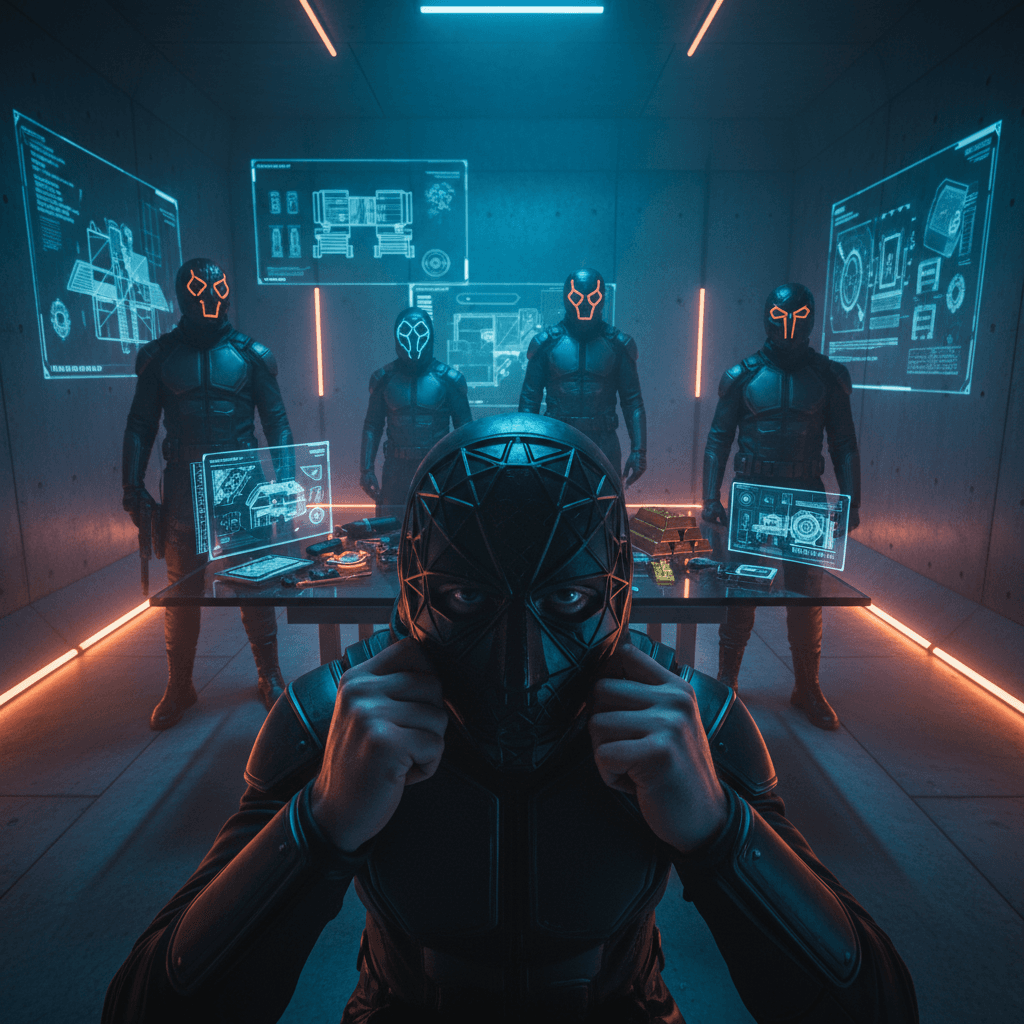
Payday: Aces High is the announcement that got the most traction, and rightly so. Fast Travel Games, the studio behind Vampire: The Masquerade - Justice and the asymmetric thriller Mannequin, is building a 4-player co-op heist game set in the Payday universe for Quest and SteamVR. Coming sometime in 2026.
The premise makes spatial sense in a way that a lot of IP adaptations don't. Planning a heist around a physical table, leaning in to examine blueprints, reaching for a mask and physically pulling it on before the job goes sideways, these are moments that use presence as a mechanic, not a backdrop. Fast Travel has already shown with Vampire: Justice that they understand VR embodiment at a craft level. If they bring that to a Payday heist, this could be the title that finally answers the question of whether co-op crime works in three dimensions the way it works in our heads.
Compass, from Trebuchet Studios (Prison Boss VR, Broken Edge), is the sleeper. An open-world piloting adventure set in uncharted skies, with grapple mechanics and ship upgrades, landing on Quest, PSVR2, and PC VR in Spring 2026. Open-world VR navigation is genuinely hard to get right. The few titles that have cracked spatial scale, that feeling of being small inside a large world, tend to become reference points for what the medium can do. Compass looks like it's trying to earn one of those slots. Spring 2026 is close enough that we'll know soon whether it delivers.
Exoshock did something rare at a VR showcase: it shadow-dropped. The Founder's Edition, at $12.99, is available now with early access to the developer build, a Quest or Steam key on full release, and other perks. The game itself is a 1-4 player co-op sci-fi shooter built, according to developer POLARITYONE, VR-first. The wrinkle is crossplay with PS5 and Steam flatscreen players. That's a design tension worth watching. Crossplay between headset and flat players rarely produces a game that serves both audiences equally well. Either the VR version gets compromised for flatscreen parity, or the flatscreen players feel like guests in someone else's living room. Exoshock's early access period will reveal which direction that balance tips.
Panoptic 2 is one of the showcase's most conceptually interesting announcements. The original Panoptic was an asymmetric game pitting a giant VR Overseer against small flatscreen challengers. The sequel scales it up to four flatscreen players against the VR perspective. Asymmetric multiplayer is one of the few genres that VR seems to have genuinely invented, where the embodied difference between a headset and a monitor becomes the mechanic itself. Developer Team Panoptes is coming to PC VR and Quest. No release date, but the concept alone earns a spot on the watch list.
The Boys: Trigger Warning launched March 26 on Meta Quest from ARVORE, the Brazilian studio behind Pixel Ripped 1995 and Pixel Ripped 1989. Published by Sony Pictures Virtual Reality, it puts players inside the Vought universe with a new character named Lucas Costa, guided by Butcher and Mother's Milk. ARVORE has built their reputation on games that are aware they're VR games. The Boys IP is a good match for the medium, given how much of the show's appeal is about physical proximity to superpowered violence. Whether ARVORE makes that proximity feel meaningful or just graphic will be the review's central question.
The port question
Flat2VR Studios showed up to the showcase three times: Roboquest VR (May 21 for Quest and a new co-op mode), Flatout 4 VR: Total Insanity (PC VR Early Access April 23), and a Trombone Champ: Unflattened DLC tease that appeared to involve Disney. That's a lot of one studio.
Flat2VR does technically competent work. Roboquest on PC VR was well-received. But three showcase slots is a statement about what the show considers newsworthy, and it's worth sitting with that. VR gaming needs studios that can port flat games well. It also needs studios whose entire reason for existence is making things that only work in a headset. A showcase anchored too heavily by port specialists is a showcase leaning on borrowed identity.
The good news is that the showcase's original reveals, Payday, Compass, Exoshock, One More Delve's physics dungeon crawler, Spymaster from Innerspace (A Fisherman's Tale), the Lightkeepers co-op survival from Spectral Games with Meta as publisher, these feel like titles with a spatial reason to exist. The port work is table stakes. The originals are what the medium is actually built on.
What's next
The calendar fills out fast from here: The Boys: Trigger Warning on March 26, Forefront 1.0 on April 23, Among Us 3D Definitive Edition on April 7, One More Delve on April 27. The Lightkeepers and Spymaster are further out, both landing sometime in 2026 with vague windows.
The showcase's fifth iteration is the most confident the show has looked. More original IPs, more crossplay experimentation, a Meta-published co-op survival title that signals continued platform investment. The questions that follow a good showcase are harder than the questions that follow a mediocre one. Not "is there enough here?" but "which of these will actually earn presence?"
We'll have answers by summer.
Cole Nakashima covers mixed reality for The Daily Vibe.
Sources: Road to VR, UploadVR, PC Gamer