 By
By Automotive OEMs spend tens of thousands of dollars per physical clay model and weeks waiting for each iteration. The business question behind Autodesk's latest announcement is straightforward: can streaming workstation-grade 3D visualization to a wireless headset compress that review cycle enough to justify the hardware stack?
Autodesk says yes, and four major automakers are already testing the thesis.
What actually shipped
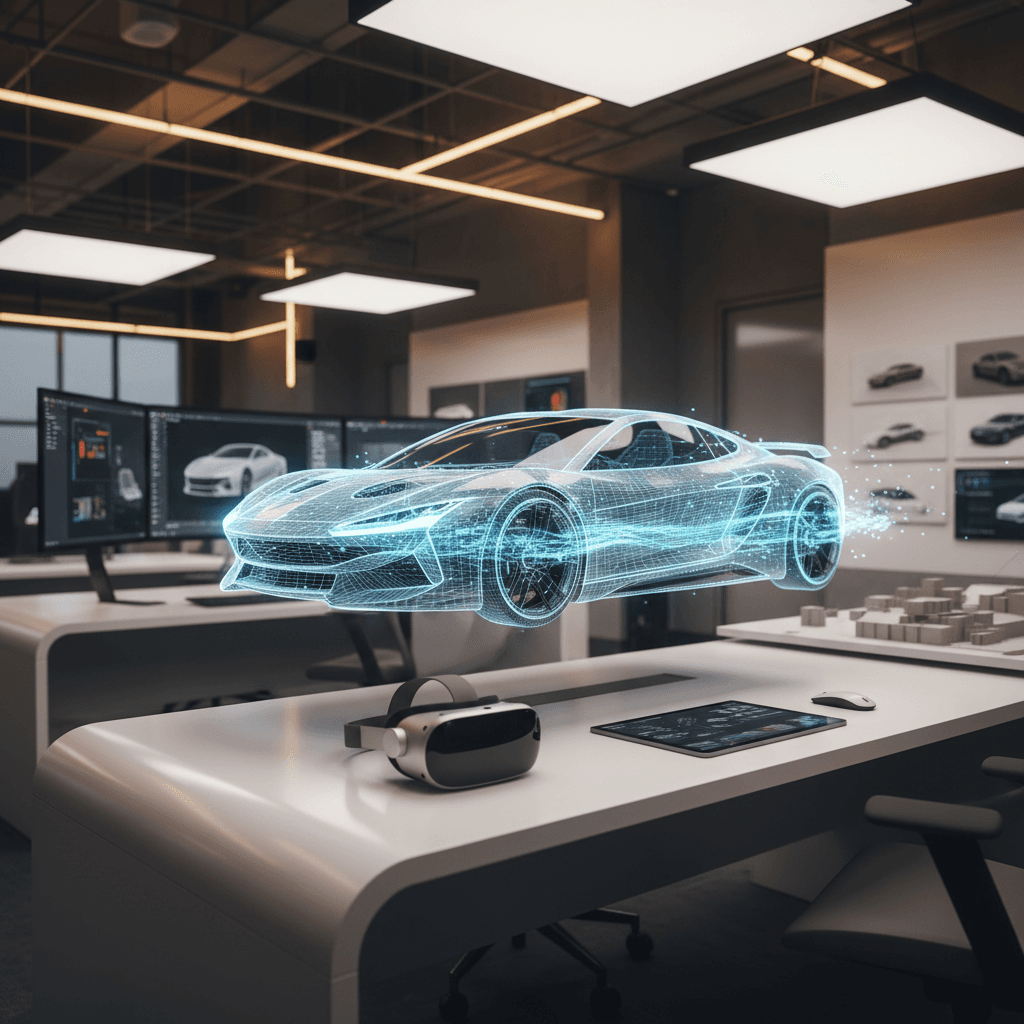
Autodesk, Apple, NVIDIA, and Innoactive have collaborated on "Immersive for Autodesk VRED," a new mode that streams VRED's full-fidelity 3D visualization to Apple Vision Pro through NVIDIA CloudXR 6.0. The feature relies on foveated streaming introduced in visionOS 26.4, which Apple released this week. The app will be available on the Vision Pro App Store when visionOS 26.4 launches publicly this spring, according to Autodesk.
The architecture is worth understanding because it dictates what your IT team will need to support. VRED continues running on a high-end Windows or Linux workstation (or a cloud PC with GPU resources). The headset is a display endpoint, not a compute node. NVIDIA CloudXR compresses and streams the rendered view to Vision Pro in real time, using eye-tracking data to prioritize resolution where the wearer is actually looking. Apple's implementation keeps approximate gaze data on-device, so it never reaches the application or NVIDIA's stack, per NVIDIA's blog post.
This is the same foveated streaming approach Valve is using for wireless PC VR on Steam Frame, which suggests the underlying technology is maturing across consumer and enterprise simultaneously.
Why this matters more than previous Vision Pro enterprise demos
Vision Pro has had enterprise showcase moments before. Porsche used standalone headsets for colocated drivetrain visualization last September. The limitation was always compute. As UploadVR noted, even the M5 Vision Pro's onboard processing is "significantly inferior to a high-end workstation GPU that draws hundreds of watts." That gap made Vision Pro a curiosity for lightweight demos rather than a serious design review tool.
CloudXR streaming eliminates that constraint. The GPU doing the actual ray tracing can be an NVIDIA RTX PRO workstation or even a cloud-hosted GPU instance. Multiple Vision Pro wearers in the same room can view the model together, draw and annotate in 3D space, and see changes reflected in real time as designers modify the asset on the workstation.
"Design reviews are some of the most critical moments in the vehicle development process," said Thomas Heermann, vice president of Automotive Design at Autodesk. "By bringing VRED to Apple Vision Pro, we're leveraging the power of spatial computing to make immersive, real-time collaboration more accessible to global companies."
Jeff Norris, senior director of Apple's vision products group, added: "Apple Vision Pro is redefining what professionals can do with spatial computing, enabling teams to visualize, collaborate and work with extraordinary fidelity in entirely new ways."
Who is using it
According to NVIDIA, Kia, BMW Group, Volvo Group, and Rivian are already using the immersive mode. Kia appears furthest along publicly.
"Integrating immersive spatial computing into our workflow with NVIDIA CloudXR for visionOS allows us to evaluate our designs at full size with greater clarity and speed on Apple Vision Pro," said Karim Habib, executive vice president and head of Kia Global Design. "We can experience proportions, surfaces, colors and materials together in a shared real-world environment and collaborate in real time across our global teams."
That quote is doing a lot of work, so let me unpack it. "Full size" matters because automotive designers evaluate proportions at 1:1 scale. "Shared real-world environment" means colocated review, where multiple people wearing headsets see the same model anchored in the same physical space. And "real time across global teams" points to the remote collaboration use case, where a designer in Seoul and an executive in Frankfurt can stand inside the same virtual car simultaneously.
Volvo Group is also featured in NVIDIA's materials, with images showing designers stepping inside a vehicle design to evaluate the windscreen-to-front transition before anything is physically built.
The TCO picture you actually need
If you're building an internal business case, the license price is where the conversation starts, not where it ends.
VRED software: VRED Professional subscriptions start around $14,080/year through authorized resellers like Novedge. CDW lists annual renewals at approximately $32,000 for a single seat. Enterprise volume pricing varies; Autodesk offers custom deals for 50+ seats, according to Vendr. Most automotive companies using VRED already have seats, so this may not be incremental spend.
Apple Vision Pro hardware: $3,499 per unit. You need one per concurrent reviewer. A design studio running four simultaneous review stations is looking at $14,000 in headset hardware before accessories and AppleCare.
Workstation or cloud compute: VRED needs serious GPU power. NVIDIA's blog mentions RTX PRO workstations and GeForce RTX GPUs as compatible hosts. A workstation with an RTX 6000 Ada runs $7,000-$12,000. Alternatively, Innoactive's Portal can host VRED sessions in the cloud with on-demand GPU access (they mention L40S or RTX 6000 GPU servers), which shifts the cost from capex to opex but introduces per-hour cloud compute fees.
Innoactive middleware: Innoactive Portal provides the streaming infrastructure and session management. Pricing is not publicly listed; they require a sales consultation. This is the hidden line item. Their platform handles SSO integration, session orchestration, and multi-device support.
NVIDIA CloudXR: The CloudXR SDK is available to developers, but enterprise licensing details are not publicly disclosed. Contact NVIDIA's enterprise sales.
Network infrastructure: Foveated streaming needs reliable, low-latency connectivity between the workstation and headset. For on-premises use, this means a solid Wi-Fi 6/6E network with low contention. For remote use with cloud-hosted VRED, you're adding wide-area network latency.
A rough back-of-envelope for a single design review station: existing VRED seat + $3,499 headset + workstation you may already own + Innoactive and CloudXR licensing (undisclosed). For a four-station studio build-out, budget $50,000-$80,000 in incremental hardware before software licensing.
IT integration friction, honestly
Here's what nobody mentions in the announcement videos.
Vision Pro runs visionOS, which means your IT team needs Apple device management (MDM) in an environment that is almost certainly Windows-centric. Apple supports Vision Pro in its existing enterprise MDM frameworks, but if your automotive design team has never managed Apple devices, there is a ramp-up.
The streaming pipeline involves four vendors' software (Autodesk, NVIDIA, Apple, Innoactive) working in concert. When something breaks, your support ticket goes... where? Innoactive positions itself as the integration layer, but you will want clarity on support escalation paths before signing.
Cloud deployment adds another layer. Innoactive offers SaaS, on-premises, private cloud, and public cloud deployment options. Each has different security, latency, and cost profiles. If your company has strict data sovereignty requirements for pre-production vehicle designs (and most OEMs do), the cloud option needs careful vetting.
Finally, the network requirement is real. Foveated streaming is bandwidth-efficient compared to full-frame streaming, but it still needs consistent low-latency wireless. In a studio environment with lots of metal, glass, and electromagnetic interference from other equipment, Wi-Fi quality matters more than Wi-Fi speed.
Where this actually saves time
The honest case for this setup is not that it replaces physical clay models entirely. Designers and sculptors will tell you (and regularly do on forums) that physical models remain superior for certain surface geometry evaluations.
The case is that it reduces the number of physical iterations. VR review catches proportion and volume problems earlier, so when the design hits the clay mill, modelers are refining surfaces rather than making wholesale changes. According to HTC's enterprise case studies, Bugatti reported that incorporating digital design tools cut a quarter of their development costs and halved design time for the Divo. (That was with earlier VR tools, not this specific VRED/Vision Pro combination, so apply appropriate skepticism about direct comparisons.)
The colocated and remote review capabilities are where the daily workflow impact compounds. Instead of flying a VP from one continent to physically stand next to a clay model, you put a Vision Pro on them and stream the full-fidelity VRED scene. The meeting happens in hours instead of weeks.
What to watch
"Immersive for Autodesk VRED" is coming later this spring, per the NVIDIA blog. That "later this spring" qualifier matters. If you're evaluating this for your 2026 design cycle, pin down actual availability dates from your Autodesk rep before committing budget.
Innoactive's role as middleware provider is worth watching. They're the connective tissue between VRED, CloudXR, and Vision Pro. Their platform also supports Meta Quest, Vive Focus, Pico, and Lenovo VRX, which means you're not locked into Apple's ecosystem if you want to hedge.
The bigger signal is that NVIDIA, Apple, and Autodesk all showed up together at GTC to announce this. That level of coordinated effort from three companies that do not historically collaborate closely suggests real enterprise demand pulled this into existence rather than a technology looking for a problem.
For the person building the business case: the technology stack is credible, the early adopters are credible (Kia, BMW, Volvo, Rivian are not tire-kickers), and the use case is specific enough to model ROI against. Get clarity on Innoactive and CloudXR licensing before your budget meeting. And make sure your Wi-Fi can handle it.
Theo Birch covers enterprise XR and spatial computing for The Daily Vibe.